Showing posts with label Motivation. Show all posts

Wednesday, April 4, 2012

Don't Be Afraid Of Success


No, that isn’t a typo.  The fear of success is a very real thing and it’s probably something that just about everyone has experienced even if we didn’t realize it.  I’ve seen the fear of success manifest itself a number of times with my clients and it can be one of the biggest challenges to get over.

Why are people afraid of success?  Doesn’t everybody want to have what they want?  Yes and no.  

Psychologists have pinpointed a few reasons for a fear of success with the biggest reason being that feelings of excitement are very similar to feelings of anxiety.  The same rush of emotions that gets us excited to achieve our goals can quickly turn to feelings of anxiety over the possible failure of reaching those goals.  There is also the anxiety of how being successful will impact the life they are currently living. 

I've recognized a fear of success in a number of people I’ve worked with and with myself.  I’ve seen it as a manifestation of the following things:

-Fear of being recognized for accomplishments
-Feelings that they are undeserving of success
-Feelings that they don’t have what it takes to be successful
-Success is going to take them out of their comfort zone

The last one I feel is the biggest barrier to people being successful in their endeavors.  A lot of people want to lose extra weight.  Nobody wants to be the person who sticks out from the group and eats healthfuly when nobody else is.  Everybody wants to lose extra fat.  Only those that realize the amount of hard work and sacrifice that goes into it and are willing to do it and maintain it are going to be successful.

Everybody wants to earn extra money.  Not a lot of people want to take investment risks or get up early to work on projects.  Not a lot of people want to go back to school.  There are those that don’t want to put up with the hassles that extra money can bring.

What is it about this comfort zone that traps so many in cycles of failure or worse yet, not even trying?  To me a comfort zone includes two things; a routine and the people within that routine.

Most of us our creatures of habit; we get up, go to work, come home, watch TV, go to bed, and then do it all over again.  We do it day in, day out ad infinitum. The scenery never changes, the boat never rocks, and the faces all stay the same.  For some this is perfectly fine.  They enjoy the routine and the people therein.  They don’t have a care in the world.  But for those that want to change something for the better this routine can be a prison.

In a recent blog post Mark Sisson highlighted the phenomena of akrasia.  Akrasia is essentially acting against one’s better judgment.  We know we should eat more healthfully, we know we should go to bed at reasonable hour instead of mindless TV watching or internet surfing, we know we should go to the gym.  But yet we don’t.  We do all of the things we know are bad for us even though, to an outside observer, it would be just as easy to make the right choice instead.

This is where the people within our comfort zone come in.  Just about every success guru out there has a rule about the people you surround yourself with.  In a nutshell, you are the average of the five people you spend the most time with.  If you surround yourself with positive people who make choices that positively impact health and well-being chances are you will too.  If you surround yourself with negative, fast-food eating people more than likely you will be that too. 

The way the last two sentences were written makes it sound like it is a decision we all make.  It most certainly is but a lot of people didn’t choose those five people.  They are usually family, coworkers, or lifelong friends.  They are the people that most would never think of pushing out of their lives.  At least not family or friends. 

When it comes to the fear of success and the self-sabotaging effects of akrasia I believe these people are at the crux of it.  Deep down most people are loyal and would never think of telling close friends and family that they are bad for their health or success.  Most will keep those people in their lives and fight the uphill battle.

But there is one part that is even worse than that.  Most people trying to elicit a positive change after years of negative behaviors and habits have a will power that is about as strong as a house of cards.  All it takes is one or two comments from a loved one to bring it crashing down.  They don’t even have to be negative comments.  It could be something as simple as, “It’s my birthday and you aren’t going to have any cake or ice cream?  Come on, it’s my birthday.” 

It could also be something as bad as, “Oh, you’re trying to lose weight?  Why?  You think you’re better than us?  Come on man you’ve been fat your whole life.  Stop kidding yourself.”

Getting rid of this negativity is one of the hardest things any of us will ever have to do.  We can see how it could be good for us in the long term but can’t get past the shit storm it will cause in the short term.  Thankfully I’ve only had to do this once in my life.  There was a shit storm definitely, but it was well worth it.  The feeling of being free from the stress and negativity that the relationship was causing was one of the greatest I’ve ever felt. 

So what can we do to get over this fear of success and get out of the cycle of negativity that surrounds us?  Here are a few steps to take to help you along the way.
1.    
  Create a concrete, definitive goal.  Don’t say you want to lose weight or make more money.  These are loose goals and will not help you along the way.  Give yourself an exact amount of weight or body fat to lose or how much more money per month you realistically want to make.  Something that is measurable and will be able to tell you if you are successful in that goal or not.
2.      
Create a “why” for your goal.  The “why” is just as important as the goal itself.  The “why” gives your goal purpose.  It keeps your eyes on the big picture.  When we think of goals in terms of being there for our grandkids or providing a better life for our family it becomes easier to stick to those goals.
3.     
Do something every day to bring you closer to that goal.  Change requires action.  And big, positive change requires big, positive action.  But it doesn’t have to be big all at once.  Start small and let things snowball from there.  Trying to completely overhaul your life works for a few people, but for most of us it’s the small things we do every day that eventually add up to the big changes that are required for big goals.
4.      
Failure is not final.  Do not let it define you.  Everyone slips up.  That’s a fact of life.  Rich people started out bankrupt.  Fit people have moments of weakness and cheat on their diets.  You are no different.  Accept past failures for what they are, learn from those mistakes, put your head down and keep moving forward.

The Wisconsin state motto is “Forward” and it is very fitting here.  No matter what happens or what action must be taken just keep moving forward and don't let the haters bring you down.

Friday, March 23, 2012

It Pays To Be A Winner


The US Navy SEALs have two unofficial mottoes and both pertain to their training, BUD/s.  One is “The only easy day was yesterday” and the other is “It pays to be a winner.”  Most will get the first.  SEAL training is by far the most arduous of all the armed forces, even among elite units.  It’s 26 weeks of nonstop training with the infamous “Hell Week” coming in week 3.  Then they still have 23 weeks left. 


But not many know about the second motto which is said by the drill instructors during pretty much every evolution (training drill).  Some evolutions are done individually but most are done with your boat team.  As you can imagine, the people that make it into and through BUD/s are highly motivated and competitive.  The instructors use this to their advantage to create an atmosphere of winning.  If you or your boat team “wins” an evolution you are rewarded while everyone else is punished.  Usually this means you get to sit while everyone else has to do more training.

In the real world there are winners and losers.  In the SEAL world the losers are dead, end of story.  The instructors HAVE to create that personality in their recruits to always win no matter what.  Otherwise they won’t be coming home. 

Losing for most of us doesn’t carry that finality but shouldn’t be taken as lightly as it is.  You’re probably telling yourself that you don’t compete in anything so therefore you don’t lose.  Ha ha ha you’re chuckling to yourself.  To that I give you Teddy Roosevelt who would’ve been all upside yo’ head if he heard such a bullshit response.
It is not the critic who counts; not the man who points out how the strong man stumbles, or where the doer of deeds could have done them better. The credit belongs to the man who is actually in the arena, whose face is marred by dust and sweat and blood; who strives valiantly; who errs, who comes short again and again, because there is no effort without error and shortcoming; but who does actually strive to do the deeds; who knows great enthusiasms, the great devotions; who spends himself in a worthy cause; who at the best knows in the end the triumph of high achievement, and who at the worst, if he fails, at least fails while daring greatly, so that his place shall never be with those cold and timid souls who neither know victory nor defeat. 
Before we go further let’s look what losing is.  Losing to me takes many forms and permeates every aspect of society.  It could be getting fired or getting passed up on a promotion.  Losing is getting a divorce or worse, catching a cheating spouse.  Losing is failing a test or class.  Losing is getting cut from a sports team.  Losing is going on welfare.  Losing is losing the state championship.  Losing is your business going under.  Losing is missing a weight.  Losing is not giving full effort in what you are doing,  Losing is taking a back seat in life while everybody else gets ahead.  Losing is doing nothing about your sad state of affairs.

What most people don’t get or refuse to see is that none of those things are final.  A Navy SEAL loses and he dies.  I’d sure-as-shit be hell bent on winning if that’s what losing meant.  A civilian loses and life goes on.  But we the normal people get stuck in a state of learned helplessness and think there is nothing we can do about it.  To some losing a job and going on welfare means staying unemployed and staying on the governments doles forever.  That right there is worse than the actual losing of the job in the first place.

There is nothing wrong with losing in the sense that we are talking about…as long as you keep trying to win.  Lost your job?  Get another one.  Wife left you for another man?  Let the pain heal and move on with your life.  Didn’t make the team?  Train harder than the competition and make it impossible for the coach to cut you the next year.  Losing doesn’t have to carry the weight of a car crash.  It’s not game over.  It’s a roadblock.  There is always a way around it.

Everybody loses.  We’ve all heard about Michael Jordan being cut from the basketball team in high school or how some of the richest people in America were once bankrupt and out on their ass.  Or how Edison tried a thousand different combinations before he finally got the incandescent light bulb to work.  His quote on the matter sums up a winner’s attitude to losing, “I did not fail 1000 times.  I merely found 1000 ways that will not work.”  (For all the history nerds I know he wasn’t the first to patent the light bulb.  The quote was merely to illustrate my point.  Nerds.)


Everybody falls.  But those that fall forward are the best for it.  Those that see the mistakes that were made and fix them are the ones who win.   

But enough of that loser talk.  Let’s talk about winning and what it can do for you.  Winning has a number of positive effects physiologically and psychologically.

When a person perceives themselves winning they experience a spike in testosterone production.  This spike in testosterone can lead to what is known as the “winner effect”.  This is where winning something, whether it’s getting a job, winning a game of Scrabble, or fending off territorial intruders, leads to subsequent wins.  In a word, it gives you self-confidence.

Many times this is all someone needs to get the snowball rolling.  You do something good and you have this surge of hormones that multiply the feeling and you want that feeling again.  So now you start busting ass to win each little battle that leads to victory in the big things in life.  The opposite is also true.

The “loser effect” is the exact same thing as the winner effect, just in the opposite direction.  You lose little battles consistently and you’ll have a mentality that things never go your way and the boss hates you and you’ve never been good at math so why even try and on and on for the rest of your life.  Screw that.

As much control as psychology can play a role in our actions and mentality it’s never final.  Now I’m not saying someone with clinical depression, PTSD, or bipolar disorder just needs to turn that frown upside down.  I’m saying that if you don’t have any severe mental issues but you feel like you’re at the bottom of the totem pole it’s usually you that is keeping you there.  Once you realize it is your own excuses and fears of failure that are preventing you from breaking free from your cycle of losing can you start to do something about it.

This post could go on forever about getting out of toxic relationships and environments and all the rest of the factors that play into the loser effect.  It comes down to the simple fact that if you are unhappy it is solely up to you to fix it.  If you are tired of the life you live stop making excuses and do something about it. 

Right now. 

Today. 

There is no tomorrow, there is no the-diet-starts-on-Monday, there is only today.  Start right now.
Maybe a few butts.  BIG ONES!  Winning.
I want you all to be winners.  Put yourself in positions to be successful.  Start with something small and let it grow from there.  And remember, failure is not the end; failing forward is a huge positive.  But you have to make it a positive.  Failing forward leads to big wins in the future.  Failing and then quitting is living death.  And living death is being a zombie.  And I have sworn to destroy the brain of any zombie I come across.
  
My work here is done.
True story.

Thursday, March 8, 2012

It's All Mental

We’ve all heard the terms “overachiever” and “underachiever”.  An underachiever being an individual who possesses great skill or intelligence yet consistently fails to live up to expectations.  The flip side is the overachiever.  This is an individual who does not possess remarkable attributes yet achieves great success, mostly through sheer will.  What is it that separates the two?  Why does the individual who is set up to win lose, and vice versa, why does one win when they are not supposed to win?

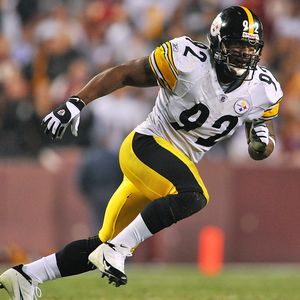
He was cut multiple times yet became one of the most feared NFL players ever.
To me it all comes down to an emotion, nay- an instinct- that is largely frowned upon in modern society and one that is being bred out of the modern male.  It all comes down to aggression and the quality of being aggressive.  Now this isn’t frat boy at a party aggressive.  We’re not talking about the people that are over-the-top Type A and are more or less assholes.  I’m talking about people who take challenges head on and give their all to come out the victor.  The untrained eye may even mistake aggression with enthusiasm and vigor.

Here is an example I see every day.  I’m teaching a hang clean to an athlete.  The athlete has the mechanical skill to do the lift but it still looks off.  The bar moves slow and they “catch” it with their hands out in front of them and then pull the bar to their shoulders instead letting it come to their shoulders in one smooth motion.  In other words they aren’t aggressive with their hip pull and use their arms for much of the lift.  My go-to cue in this case is to simply be aggressive.  I tell them that I don’t want them to pull the bar so that it gets to their shoulders; I want them to pull that bar so that it flies through the ceiling!  A lot of times it works, but sadly some athletes get stuck in the thought that being aggressive is bad or are too shy to display it.

Aggression takes on many forms and wears a slew of hats.  There is the example above along with the 190 pound defensive tackle who somehow leads his high school team in sacks and tackles, the 40 year-old millionaire who grew up on a steady diet of government cheese, the man who sees a mugging in progress and actually does something about it, the firefighter who doesn’t think twice about running into a burning building, or the Marine who doesn't even think once about running into a firefight to save his buddies.  These are all examples of people being aggressive.  Their stress response is triggered, there is a cascade of hormones, and they use their physical and mental capabilities to affect the outcome for the betterment of society and for themselves.

But like I said in the beginning, there is a systematic attack on aggression in society.  The largest and most successful chain fitness center in America prohibits grunting.  They actually have what are called “Lunk Alarms” that go off if someone grunts or drops a weight or does anything that might occur in a normal lifting setting.   It’s Planet Fitness if you wondering.  I could write a whole article on my hatred of that place.

The attack on aggression even starts in little kids.  Kids are going to fight, that’s a known fact.  I distinctly remember the day my sister stopped picking on me forever.  She hit me and I went and told my dad.  His response was to hit her back.  And I did, with a vengeance.  Problem solved.  But now if two kids get in a fight at school they may be expelled or suspended instead of being told to not do it again and to work out their differences elsewhere.  Paul Carter on his blog has an interesting take on why there have been more school shootings in recent years on his blog.  It basically comes down to the fact that instead of being able to release their aggression and work out differences kids are forced to bury their anger until it comes out with geyser-like force and ends in something much worse than a small fist fight.

You stay outta this, lady.
But I’m digressing from my main point.  Unless you are a genetically gifted athlete, which you probably are not, then getting better takes an attitude.  It takes an attitude that you are going to work harder than the competition.  It takes aggression towards whatever is in opposition to getting what you want.  That could be an opponent standing in front of you or it could be a heavy-ass barbell resting silently on your back.  Both want you to be a crumpled heap on the ground.

Recent research has even shown that the point of exhaustion that we have all felt at one point or another is a psychological perception and not a physiological fact.  That’s to say, when you quit due to exhaustion, fatigue or whatever YOU have made the conscious decision to quit.  Your body could have kept going; it’s your brain that quit.

Quitter.
If you don’t believe me I invite you to watch any of the multiple documentaries on the internet that detail Navy SEAL training or BUD/s.  Every one of the men that complete the training has the innate ability to silence the voice in their head that screams for them to stop.  Shit, just the training that is done to qualify for BUDS/s would take out most "hardcore" lifters.


Is this an optimal way to train all the time?  Some would say yes but I’m more of a mind that you need to pick and choose your battles.  But when you’ve chosen to go all out, THEN GO ALL OUT!

It is sometimes hard to coax that inner aggressor out of these kids.  A lot of times becoming a better athlete is the first thing they've ever had to put any real physical effort into.  But once they realize that going through the motions and being cautious, and trying not to stick out aren't going to cut it good things start to happen.  You can see them before a lift talking to themselves in their head, silently building a rage and contempt for whatever it is that seeks to hold them down, be it a barbell or all the people that have doubted them.

If you've never felt that primal urge that one of your ancestors felt when he scaled a hill only to be confronted with a hungry sabre-tooth tiger then you are lost my friend.  You’ve let society pull you towards the middle, towards mediocrity, towards not standing out.  But if you feel that same rush of adrenaline that your ancestor got when you’re looking at a bar loaded with a weight that you’ve never lifted before, if you imagine that bar mocking you saying, “Come on you piece of shit, give it a pull.  Doesn’t matter to me.  You.  Don’t.  Have.  It.”  And if you let that hatred of being told you can’t, of being told you’re not good enough, of being told you don’t have the genetics, of being told to give it up, pack it in and go home, and then you grab the bar and rip it from its resting place and hoist it aloft in defiance of everything and everyone that would attempt to hold you down….well, my friend....you’ve got a chance.  And if you’ve got the attitude and the aggression, a chance is all you need.

Related Articles:


Get Comfortable Being Uncomfortable
Musings on the Consequences of the Participation Trophy Generation
The New Year's Resolution Solution
Hard To Kill

Sources:
http://running.competitor.com/2010/03/features/sports-science-update-perception-is-everything_9067

The limit to exercise tolerance in humans: mind over muscle? Samuele Maria Marcora and Walter Staiano.  EUROPEAN JOURNAL OF APPLIED PHYSIOLOGY Volume 109, Number 4, 763-770.

Thursday, February 9, 2012

The Bruce Lee Method

“Be like water making its way through cracks. Do not be assertive, but adjust to the object, and you shall find a way round or through it. If nothing within you stays rigid, outward things will disclose themselves.” –Bruce Lee

When it comes to quotes on either philosophy or weightlifting or the philosophy of weightlifting Bruce Lee quotes get a lot of play.  Bruce Lee was known as a very wise man and also a devotee to training the body to be able to do and handle uncommon tasks.  The quote above is one that I constantly remind myself of because it is very applicable to the strength training world.  It’s also a quote that advocates trial and error.  Even though I think a lot of people (especially “experts”) would be hesitant to admit it trial and error is a necessary process towards achieving your fitness goals.

Source: Wikipedia
The water quote is the basis of how I set up my training and nutrition programs for myself.  I’m going for maximum results in the shortest amount of time.  I used to be the guy who would read this great routine or diet plan and instantly set it up and run it hoping to get the kinds of results the author(s) promised.  Oftentimes I would see results but would be somewhat disappointed.  Cookie cutter programs yield cookie cutter results.

This is because there is no such thing as a magic bullet program.   A program that works great for me could be a disaster for someone else and vice versa.  So when I’m setting up my training I try to be like water.  If something doesn’t work I change my path instead of continuing to bang my head against the rock trying to force the program to work.  That is never the smart way to go.

Find your own path.
Now there are many programs and courses out there that have yielded awesome results for a lot of beginning lifters.  But that’s the catch.  Beginning and intermediate lifters will make progress on almost any program as long as it has some well thought out progression to it.  Mark Rippetoe’s Starting Strength and Jim Wendler’s 5/3/1 are two of the most popular programs for beginners and intermediates, respectively.  I’ve never tried Starting Strength but have borrowed some of the ideas for some of the beginner lifters that I train.  I used Wendler’s 5/3/1 for about a year and made some awesome progress on it.  It was easy to set up without a lot of thinking and I got stronger but I eventually got to a point where I felt like I was spinning my wheels.  So I went in a new direction.  There is nothing inherently wrong with the programs themselves, they just weren’t right for me at that time.

One thing that I want to make clear is that I’m not advocating a huge change if something isn’t working.  Often it’s the small changes that make the biggest differences.  Maybe if I had modified a few small things when I was doing 5/3/1 it would have continued working for me.  It’s all about knowing who you are and adjusting based on that.

The same goes for nutrition.  You’ve got Atkins, Paleo, Mediterranian, South Beach, Carb Cycling, and all the permutations under the sun.  Where do you start?  Some people feel great, perform awesome, and look good eating high carbs, moderate protein, and low fat.  And some people feel great, perform awesome, and look good doing the exact opposite.   And a lot of people fall somewhere in the middle.

The point I’m trying to make is that no two people are alike.  Two people with the exact same anthropometrics (height, weight, strength, etc.) will respond differently to the same training and nutrition program.  It’s the same reason why a skinny 15 year-old kid should not copy and paste the routine of a 250 pound professional body builder that’s being hyped in the latest edition of FLEX. 

So now, this article begs the question, “What should I do?”  Like I said at the beginning, it’s all about trial and error.  Here are a few guiding principles to help you build a routine that works for you and how to recognize if it doesn’t.

1.      1.  Pick a goal- The more specific you are, the better off you’ll be.  When you decide upon a specific goal everything you do should be done to get you closer to that goal.  An example would be, “I want to get in better shape.”  Great.  So do I.  But better shape to me is probably way different than better shape to you.  If you want to lose weight pick a specific target weight or body fat percentage.  If you want to get stronger pick a few core exercises and work to progress your numbers.  Being specific gives you something almost tangible.  It is a very narrow line that defines success or failure.  All black and white with no grey.

2.      2. Stick to the basics- There are things that have been used for ages to get people strong, lean, and in better health.  And then there is the modern crap that is of little use other than to fleece you of a few bucks.  No matter your goal lifting weights in the core lifts like squats, presses, dead lifts, and weighted carries and eating a diet made up of foods with only one or two ingredients is probably going to be the best way to start.  From there, modify and make small changes to suit your goals.

3.      3.  Keep track of progress- That means keeping training and eating journals, keeping track of body anthropometrics (weight, skin fold measurements, body circumference measurements, etc.).  If you don’t know where you started or where you were the week before you have no real way of knowing if you got better or worse.  On the same token if you do the same thing day in day out and week in week out your body is going to adapt and all you’ll do is stay the same.  Maybe that’s all you want but if you haven’t reached your goal you need to change something up.

4.      4.  Make small changes first- If you feel that you’re stuck as far as progress goes first think critically about what it is that is holding you back.  If you’ve been losing weight a reduction in body mass requires a reduction in caloric intake.  If you’re strength levels have leveled off perhaps your set rep scheme needs to be changed up a bit or perhaps your recovery methods should be looked at.  Whatever the case may be do not completely overhaul what you are doing. Results are never linear and are very hard to predict.  Sometimes all you need to do is to stay the course and let it work itself out.  Either way small changes can lead to big improvements.

5.      5.  If something no longer meshes with your goals drop it- If you do recognize something that is holding back your progress then you need to drop it.  If you want to get stronger or lose weight but you feel that Tuesday night darts with including beer and wings are holding you back then you have a decision you make.  Do you sacrifice progress or you social life?  There is no right or wrong answer as it’s a case by case decision.  Just don’t complain about not losing weight when you keep up with the darts, beer and wings.

Fitness is not an end point. Your goals should not be thought of as end points. They are more check points on your lifelong journey. Reaching goals are great, but once that goal has been reached a new one must be set. And when a new goal has been set then a new path must be taken. Even maintenance can be a difficult task if not done diligently.

In the end always be thinking about where you are, where you want to be, and the best path to get there. If that path is the one you are then stay the course. If it is not, then let yourself flow in a slightly new direction to find your way to the other side.