Showing posts with label Training. Show all posts

Tuesday, May 29, 2012

What A Beautiful Snatch You Have!

Ah, the snatch.  It is, without a doubt, my favorite exercise to watch and perform.  The finely-tuned mechanics coupled with otherworldly raw power required to be the best in the world make it a spectacle to see.  In case you are unfamiliar, the snatch requires the lifter to bring the bar from the ground to overhead in one motion.  Here is Dmitry Klokov, one of the best weightlifters in the world, doing his thing with 205 kilos.  For all of us ‘Mericans, that’s 451 lbs.  Sheeeeit.


Up until my summer internship in 2006 at NX Level I was only somewhat aware of the lift.  I had never done it before.  Since we have our athletes perform the hang version I had to learn myself up quick.  I’m not afraid to say that I was definitely afraid of doing it with any kind of serious weight.  By then I had seen what could happen if you let an elbow or shoulder get a little lose during the lift.  But I started slowly with an empty bar and became mildly proficient at it to the point that I could teach it to athletes. 

We don’t test our athlete’s max on the lift however and never do the full lift (from the platform).  We use it as a means to an end.  From an athletic performance standpoint the snatch is great for teaching and developing explosive power through what is called the triple extension.  This is the rapid and forceful straightening of the hip knees and ankles.  This is what happens in the lower body during a jump, acceleration, and a bone-jarring tackle.

In the little over five years since I first started doing the lift it has come and gone a couple of times in my training.  Because of this there is one definite that I can tell you about the lift.  To be good at it you have to do it.  A lot. 

Performing the snatch doesn’t make you stronger, per se.  The weight is usually too low to get any kind of adaptation from it.  Performing the snatch relatively often in your training, like 2-5 times per week, makes you more efficient at the snatch.  Squats, dead lifts, and presses will make you stronger in the positions that you are put in during the execution of the lift.  Snatching and becoming more efficient ensures there is no wasted effort or faulty mechanics that will cause a missed lift.  My best effort in the lift came when I was practicing it three times per week (100 kilos or 220 lbs. in case you were wondering!).  To me that’s why I like it.  It requires great efforts of strength, technical prowess and concentration.  It’s a lifter’s lift.

If you are thinking about using the snatch in your training or want to see what kind of weight you can do I would strongly urge you to seek out a coach who can teach you the proper way to perform the lift safely.  There is even a chance that the snatch will not be a lift that you can perform safely due to underlying movement dysfunctions whether it be immobile hips or tight shoulders or some other contraindication.  If you don’t get a qualified coach you could end up like these clowns.  That would be bad.

Friday, March 30, 2012

Lift Fast To Get Fast?


Every athlete that trains at NX Level gets a postural assessment and movement screening.  This gives us a starting point as to where the athlete is physically.  It basically lets us know if there are any imbalances or pathologies that need to be addressed.  But before that begins we ask each athlete what their goals are as far as their athletic careers are concerned and what they would like to get out of training with us.  I would say at least 70% of our athletes say they want to get faster and be more explosive.

Assuming there are no overwhelming muscle imbalances (everyone has some to some degree) or other pathologies, this article is going to take a look at what things can be done in the weight room to increase speed and explosiveness.

But first let’s look at the things inside the body that are going to dictate that speed and explosiveness.  The way I see it, there are three things (maybe four but we’ll get to that) that are going to dictate how explosive an athlete is.  These are, in descending order, intramuscular coordination, intermuscular coordination, and overall muscular strength.

Intramuscular Coordination
Intramuscular coordination refers to how you muscle is activated when presented with a task.  Muscles are comprised of, depending on how specific you want to get, 3-7 different types of muscle fibers.  For the sake of brevity we’ll focus on the three main ones.  These are Type I, Type IIa, and Type IIb. 


Type I Fibers
Type I muscle fibers are what are commonly referred to as slow-twitch fibers.  These fibers are not very strong but are very fatigue resistant.  They are also much thinner than their Type II counterparts.  Type I muscle fibers are found predominantly in muscles that control human posture and fine motor control since they can easily be held in contraction without much effort.  Elite distance athletes will also generally have more Type I fibers throughout their body which gives them an advantage. 
When presented with a task, such as lifting something, these muscle fibers are recruited first.

Type II Fibers
Type II muscle fibers (a and b) are generally referred to as fast-twitch.  These fibers are the opposite of Type I fibers in that they can produce large amounts of force but fatigue rather quickly.  These muscle fibers are found in all skeletal muscle that requires large amounts of force to be produces.  Generally if you can see a certain muscle on a body builder, it has a high amount of Type II fibers.
Type II fibers are broken down into two classes.  Type IIa are intermediate fiber types.  They can use aerobic and anaerobic metabolism to produce energy.  Type IIb use only anaerobic metabolism.  Type IIb also have the fastest rate of firing which is why they can produce large and quick burst of power.

Muscle Fiber Recruitment and Rate Coding
When a muscle performs a certain motor task not every fiber is contracted.  We don’t need large bursts of energy to write our names or jog a few miles.  But when we need to pick 500 pounds up off the floor or need to escape a momma moose in full rut then we are going to need every single one of our muscle fibers working to get us the hell out of there.

One of the most interesting differences that humans have from our cousins, the chimpanzee, is this muscle fiber ramping up.  Chimpanzees have less grey matter in their spinal cords.  This grey matter controls fine movement, such as writing out name.  Without this grey matter chimps essentially recruit ALL of their muscle fibers for every movement.  This is why they appear to be so much stronger than humans even though they are much smaller than us.  So somewhere along our tine of evolution we humans gave up ten foot verticals, 500 pound bench presses, and 3.0 second 40-yard dashes so we could write in cursive and run marathons.  Awesome.

Rate coding refers to how many times per second the muscle receives an action potential from the nerve that innervates it.  Without getting into sliding filament theory this action potential tells the muscle to contract.  Generally the more times per second the muscle receives that stimulus the stronger it is going to get.
So where does intramuscular coordination play into all of this?  Well, some people are much more efficient at recruiting their Type II fibers than others.  And the quicker you can tap into those large fibers the higher rate of force you are going to produce.  Some people have a higher rate coding than others.  And not only does this rate coding start high, but it stays high throughout. 

Think of this as the difference between a sprinter and marathoner.  The sprinter taps into those Type II fibers (and has a higher percentage of them) quicker than his marathon counterpart.  The marathoner has a higher degree of Type I fibers and will not tire as fast as the sprinter when presented with a long distance run.  Some of this is due to genetics but a lot of it has to do with training principles, which we’ll get to later on.

Intermuscular Coordination
Intermuscular coordination is all about how your inidvidual muscles work together to produce movement.  
This coordination is going to be highly relevant when it comes to form and, more importantly, energy leaks.
Using the example of a vertical jump, when performing an explosive movement just about every muscle in the body works in unison to create as much force as possible in the direction you want to go.  The big movers, the muscles that do a lot of the work generating force, are going to be the quads, hamstrings, glutes, hip flexors, and calf muscles, but there are a lot of other muscles that come in to play that if not properly engaged will cause a less than 100% jump.  The core muscles transfer force from the leg muscles to the upper body, the arms swing forward to provide propulsion, the small muscles of the lower leg and ankle provide support for the joints, the muscles of the neck and shoulder girdle contract to support the head.  And on and on and on.

If any of those muscles groups fire late or not at all energy will be leaked all over the place.  In other words, it’s wasted.  It goes off into space, back to its own planet, never to be seen or heard from again.

Muscular Strength
Muscular strength is how much force a muscle can produce on the surrounding joint.  It is dictated by fiber type, fiber size, fiber density, recruitment efficiency, and rate coding.  As you can see, intramuscular coordination plays a big role in how strong a muscle is.  Two people with the same size muscles can have two totally different strength levels.  This is generally seen when comparing elite body builders with elite power lifters.  The body builder has large but not very dense muscles.  The power lifter may have smaller muscles, but they are much denser.  That is, there are more fibers per square inch of cross sectional area.

There is also a mental aspect that plays into how much force a person can generate.  This goes back to the concept of aggression in training.  A trainee that is going “balls-to-the-wall” is usually going to generate more force than someone going through the motions.  Both have their place in training but when trying to be as explosive as possible the balls-to-the-wall mentality is going to be your best bet.

The Need…The Need For Speed
So now that we know what dictates explosiveness how then do we train for it?  Short answer…get stronger.  Many studies have shown that A) the stronger the athlete, the higher correlation to higher performance.  In a study performed on elite soccer players in England the strongest athletes had the highest vertical jumps and fastest sprint times.  And B) when studied side by side groups that performed strength exercise with weights that were closer to their 1RM improved more than groups that performed the same exercises at lighter weights but faster.  A study performed on netball players showed that the group that strength trained had a greater improvement in throwing velocity than the group that performed velocity-specific exercises (kept weight lighter but moved it faster during training). 

But it’s not just about strength.  Strength is no good to an explosive athlete if that athlete can’t express that strength as an aspect of speed.  They still need to generate that high degree of force in an extremely short amount of time.  The best way to go about this is to train both concurrently. 

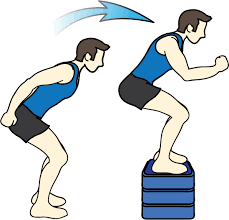
Strength sessions should include both basic strength exercises and explosive moves.  An example would be to perform squats and then box jumps right after.  All of the fibers should be turned on from the squats and ready to fire on a moment’s notice.  The jumps will take advantage of this improvement in motor recruitment.  Even if there is not an improvement in height during the session, the nervous system is being trained to tap into the strong and explosive Type II fibers right away instead of just relying on the weaker and slower Type I fibers.
Hmm.  Makes sense.
One other thing to consider when it comes to strength training for speed; there is this tricky thing called the “intent to accelerate”.  I’ve written a little bit about this before but it is essentially trying to move a weight fast even though it is too heavy to do so.  When I’m training I’m all about this.  Telling myself to move a weight as fast as possible is a great way to give myself a little boost.  I’m sometimes hesitant to do this with my athletes, however. 

Most of the kids I train are in high school and thus don’t have the experience to do this properly and safely.  Many times they will relax at the bottom of the movement in an attempt to “wind up” and move the weight fast.  This is never a good thing and leads to energy leaks at best and missing the weight and possibly getting hurt at worst. 

When training these athletes it’s important to pick loads that will allow them to move the weight with speed without any special focus on it.  Usually kids of this age are going to benefit from simple linear progression where weight is simply added to the bar each session.  This allows them to learn the lift, get some muscle-building volume, and stay safe while still get stronger.


This done in concert with more sport specific drills such as jumping, throwing, and sprinting is going to produce the desired effects of enhanced speed, explosiveness, power, and performance more so than focusing solely on velocity-specific exercises.

A Final Word
This article assumed the athlete had no pre-existing muscle imbalances or pathologies.  This is rarely the case in the realm of today’s youth athletics.  When kids only play their sport year round with no focus on training their bodies to handle the rigors of that activity imbalances are going to occur.  When an athlete develops these imbalances it becomes increasingly difficult and sometimes impossible for them to get into the proper positions to be as explosive as possible.

I’ll use the example of the vertical jump.  The proper jumping position is created by flexion at the hip, knee, and ankle.  When any one, or a combination of all three, of those areas are tight from muscular imbalances somewhere else picks up the slack.  For many athletes this is the lumbar spine.  So instead of using the big, powerful, Type II dominant muscles that surround those joints to push themselves up, they use the small postural muscles of the low back to throw themselves up.  Obviously their jump performance is highly diminished but more importantly the repeated stress to an area that wasn’t designed to handle such loads is going to lead to pain and possibly injury.

In conclusion, to become faster and more explosive on the field or court you must train for such activities.  Getting stronger on the basic lifts to better overcome your own inertia, along with performing more sport-specific drills is the tried and true way to run faster, jump higher, and deliver more powerful hits.  Lift, sprint, jump.  It’s as simple as that.

Sources:

Velocity specificity, combination training and sport specific tasks.  Cronin, J. et al.  Journal of Science and Medicine in Sport Volume 4, Issue 2, June 2001, Pages 168–178.

Influence of Strength on Magnitude and Mechanisms of Adaptation to Power Training.  Cormie, P. et al.  Medicine & Science in Sports & Exercise: August 2010 - Volume 42 - Issue 8 - pp 1566-1581.

Is velocity-specific strength training important in improving functional performance?. Cronin, J.B., et al.  Journal of sports medicine and physical fitness 2002, vol. 42, no3, pp. 267-273.

The strength of great apes and the speed of humans. Walker, A. Curr Anthropol. 2009 Apr;50(2):229-34.

Drop jumping as a training method for jumping ability. Robert, M.  Sports Med. 1990 Jan;9(1):7-22.

Comparison of loaded and unloaded jump squat training on strength/power performance in college football players.  Hoffman, J., et al.  J Strength Cond Res. 2005 Nov;19(4):810-5.

Strong correlation of maximal squat strength with sprint performance and vertical jump height in elite soccer players.  Wisloff, U., et al. Br J Sports Med. 2004 Jun;38(3):285-8.

The effectiveness of resisted movement training on sprinting and jumping performance.  Hrysomallis C.  J Strength Cond Res. 2012 Jan;26(1):299-306.

Manthropology. McAllister, Peter. 2009 St. Martin Press New York.

Saturday, March 17, 2012

Training Update and Some Musings


Monday
Fat Bar Bench: 250x3

Wednesday
Hang Clean and Press: 198x1, 220x1, 225x1, 230x1x3
Cannons (Arms)

Friday
Dead Lift: 506x1, 440x5, 352x8
Front Squat
Shrugs

This was a pretty decent week of training.  No real gems but none of the sessions were total failures either.  My current progression three more weeks and then I’m going to switch things up a bit.  This twelve weeks has been about getting decent amount of volume in to get a solid base of strength while still keeping weights moving fast for the most part.  In this twelve weeks there should have been no missed weights.  It didn’t work out that way due in part to me not choosing correct weights to use but also because there are a few things that I’m going to change for the future.

The next six weeks is going to be all about upping the maximal strength.   I’m going back to a program that I've used in the past and got some good results on.  It’s a basic ladder progression and I’ll lay it out sometime in the coming weeks.

One thing that I’m going to try is to replace the Bench Press with Pendlay Rows as a main lift.  I’ll still do bench, but only as an assistance lift.  I think I just need more volume at lower weights to really hone in on my bench technique.  Benching heavy also makes my shoulders feel wonky for a day or two afterwards.  This is probably brought on by my less than stellar technique.

I’m still getting used to dead lifting sans belt.  It’s a strange feeling when you stand up with 500 pounds in your hands and you can feel your intestines shift and your abdominal wall literally unfold itself.  After the 506 I loaded another 20 pounds on the bar and gave it tug but someone must have glued it to the ground because it didn’t budge.  That’s a lie, I think my rectus abdominus had had enough and was about to turn towards Herniaville if I pushed it any harder.  Hence the dropping back down and getting some volume in.  My spinal erectors afterwards were all like, “Bro!  The hell, bro?”  And I’m all like, “Sorry fellas.  Abs needs a rest.”  True story.

One of the random things that pops into my head about strength is how some guys can maintain an almost elite level of strength without doing much dedicated training.  One such man is Kirk Karwowski.  KK is arguably the best squatter of all time and definitely an elite all around lifter.  He competed back in the early days of using gear such as squat suits and bench shirts.  These suits basically amounted to a very tight, very thick pair of jean shorts.  With this rudimentary equipment the man squatted over a thousand pounds.  In 2005, ten years after he’d last competed, he entered a totally raw (no support equipment) contest and squatted 826 at a lower body weight than when he competed regularly. 
13% of his strength comes from his nipple rings.
So this brings me back to the question of how do you maintain that strength?  Actually, I don’t think it’s a “how” question, but more of a “why”.  Here is my theory in two parts.

Part 1; In order to achieve the level of strength necessary to squat over a thousand pounds one must first be able to squat 500, 600, 700, etc.  And if one can squat a thousand pounds then one probably squats the lighter weight with regularity.  It’s the same if you squat 300 fairly well.  You squat 100 and 200 on a regular basis and they are no big deal.  Take a break from training, like say a year, and if you haven’t completely ruined your body it’s not going to take a whole lot to get you back to being able to handle 200 pounds.  No matter what your max is you are still capable of handling the lighter percentages whether you max is 300 or 1000.

Part 2; Many would say that he probably did a good job of maintaining muscle mass.  That he did but that’s only half the equation.  In continually placing a large amount of stress on the body the body will build bigger and stronger muscles, but also bigger and stronger bones, tendons and ligaments.  This I think is probably more important than actual muscle belly size.  The body is very good at protecting itself.  If it doesn’t have the required tendon and ligament strength to support or move a load the muscles won’t contract and you’ll likely fail the lift.  Obviously this isn’t always what happens as people tear muscles and tendons everyday but for the most part the body is going to save itself to fight another day. 

So, back to tendon and ligament strength.  I consulted Google University and couldn’t find much on tendon and ligament atrophy so I think there is something to that.  If the tendons (what connects muscles to bones) and ligaments (connect bone to bone) don’t atrophy and are at least maintained with some minimal movement I think the potential to handle what you’ve previously been capable of is, for the most part, still there.  In either case, however, it requires a huge training age to build the tendon and ligament strength necessary.  So don’t think that if you get up to a 400 pounds squat in your first year or two of training it’s going to stay with you for life.  Squat 400 for a few decades and then maybe you’ve got something.


Alright, it St. Patty’s Day and I’ve done enough thinking for today.  Be safe, drink some green beer, eat a ton of corned beef and have a great weekend.


Can't Stop Won't Stop

Saturday, March 10, 2012

Training Update, Videos, and Challenges

Monday
Fat Bar Push Press: 174x5, 160x5, 145x5x3

Wednesday
Body Weight (195) Front/Back Squat Challenge: 17/10, 10/10

Good Mornings: 5x5


Friday
Trap Bar Speed Dead Lift: 305x3x8
Gunz
Quarter Mile Farmers Walk: Hundies in each hand.  It took me 6:14 to complete.

High rep squats smoked me.  I was surprised at how many reps I did on the front squat and how few I did on the back squat.  When I made the switch and sat back into the first back squat I could feel my quads trying to do everything.  That was a weird feeling.  By rep 6 on the back squat I could feel my spinal erectors starting to go.  I stayed smart and shut it down there.  No point in getting injured.

On Tuesdays and Thursdays I’m going to start adding in some quick workouts.  On Tuesday I did some single arm dead lifts and then prowlers with rope inverted rows.  Nothing too intense or time consuming.  It took me about 30 minutes total to complete.

I love spring.  It’s by-far my favorite season.  Even though we didn’t really get a winter I’m ready for it to be warm again.  The best part is that once it gets into the 50’s it feels like it’s 70.  I just hope it stays this way.  If it snows in April I’m going to be pissed.

I’m getting pretty excited for St. Patty’s Day this year.  Normally I prefer to keep it low key since it’s usually during the week and for the most part it’s amateur hour at the bars.  But this year a bunch of friends got a drink/food special in Chicago.  I’ve challenged Eric to a corned beef eating contest.  I know I’m going to lose; I just want to see what kind of damage he can do.  I hope they have Jameson at this thing too.

A couple of my clients hit dead lift PRs this week.  Shannon, who owns a kettlebell studio, pulled 223 (metrics and shit), Matt pulled 406, and Joe hoisted 508.  I was so proud.  They’ve been following a program that I wrote up for them and it seems to be going well.  There are a few tweaks that I’m going to make to it but for the most part that shit is bananas.

The Farmer’s Walk Challenge crushed me.  Carrying half your bodyweight in each hand for a quarter mile is a lot harder than it sounds.  My hands and forearms were pretty useless after this and I even used straps. Try it.  Let me know how it goes.

The more that I think about it, when it comes to training athletes, and even adults for that matter, the speed of movement is just as important as the weight on the bar.  There is a time and place for an athlete to strain against a weight and come out on top, but those times should be few and far between.  Most sports are played in a fast reactive manner and I think a majority of their work in the weight room should be the same.  Most will say that the intent to accelerate is just as good as actually accelerating it, but what population are we talking about?  Power lifters with a decade or more under the bar or 16 year-old kids with a very low training age? 


Those that have been training a long time know their bodies and can understand the biofeedback.  Those that don’t have a lot of under the bar experience don’t know the difference between slow and the intent to be fast.  They just know they stood up with the bar.  And more than likely those that haven’t built the muscle maturity that comes with years of training are going to lose some kind of posture when attempting to accelerate a heavy load because they think it needs to be fast, not just attempted fast.  I don’t know.  I’m more or less just thinking out loud.  On a computer. 


I hope everyone has a great weekend!

Thursday, March 8, 2012

It's All Mental

We’ve all heard the terms “overachiever” and “underachiever”.  An underachiever being an individual who possesses great skill or intelligence yet consistently fails to live up to expectations.  The flip side is the overachiever.  This is an individual who does not possess remarkable attributes yet achieves great success, mostly through sheer will.  What is it that separates the two?  Why does the individual who is set up to win lose, and vice versa, why does one win when they are not supposed to win?

He was cut multiple times yet became one of the most feared NFL players ever.
To me it all comes down to an emotion, nay- an instinct- that is largely frowned upon in modern society and one that is being bred out of the modern male.  It all comes down to aggression and the quality of being aggressive.  Now this isn’t frat boy at a party aggressive.  We’re not talking about the people that are over-the-top Type A and are more or less assholes.  I’m talking about people who take challenges head on and give their all to come out the victor.  The untrained eye may even mistake aggression with enthusiasm and vigor.

Here is an example I see every day.  I’m teaching a hang clean to an athlete.  The athlete has the mechanical skill to do the lift but it still looks off.  The bar moves slow and they “catch” it with their hands out in front of them and then pull the bar to their shoulders instead letting it come to their shoulders in one smooth motion.  In other words they aren’t aggressive with their hip pull and use their arms for much of the lift.  My go-to cue in this case is to simply be aggressive.  I tell them that I don’t want them to pull the bar so that it gets to their shoulders; I want them to pull that bar so that it flies through the ceiling!  A lot of times it works, but sadly some athletes get stuck in the thought that being aggressive is bad or are too shy to display it.

Aggression takes on many forms and wears a slew of hats.  There is the example above along with the 190 pound defensive tackle who somehow leads his high school team in sacks and tackles, the 40 year-old millionaire who grew up on a steady diet of government cheese, the man who sees a mugging in progress and actually does something about it, the firefighter who doesn’t think twice about running into a burning building, or the Marine who doesn't even think once about running into a firefight to save his buddies.  These are all examples of people being aggressive.  Their stress response is triggered, there is a cascade of hormones, and they use their physical and mental capabilities to affect the outcome for the betterment of society and for themselves.

But like I said in the beginning, there is a systematic attack on aggression in society.  The largest and most successful chain fitness center in America prohibits grunting.  They actually have what are called “Lunk Alarms” that go off if someone grunts or drops a weight or does anything that might occur in a normal lifting setting.   It’s Planet Fitness if you wondering.  I could write a whole article on my hatred of that place.

The attack on aggression even starts in little kids.  Kids are going to fight, that’s a known fact.  I distinctly remember the day my sister stopped picking on me forever.  She hit me and I went and told my dad.  His response was to hit her back.  And I did, with a vengeance.  Problem solved.  But now if two kids get in a fight at school they may be expelled or suspended instead of being told to not do it again and to work out their differences elsewhere.  Paul Carter on his blog has an interesting take on why there have been more school shootings in recent years on his blog.  It basically comes down to the fact that instead of being able to release their aggression and work out differences kids are forced to bury their anger until it comes out with geyser-like force and ends in something much worse than a small fist fight.

You stay outta this, lady.
But I’m digressing from my main point.  Unless you are a genetically gifted athlete, which you probably are not, then getting better takes an attitude.  It takes an attitude that you are going to work harder than the competition.  It takes aggression towards whatever is in opposition to getting what you want.  That could be an opponent standing in front of you or it could be a heavy-ass barbell resting silently on your back.  Both want you to be a crumpled heap on the ground.

Recent research has even shown that the point of exhaustion that we have all felt at one point or another is a psychological perception and not a physiological fact.  That’s to say, when you quit due to exhaustion, fatigue or whatever YOU have made the conscious decision to quit.  Your body could have kept going; it’s your brain that quit.

Quitter.
If you don’t believe me I invite you to watch any of the multiple documentaries on the internet that detail Navy SEAL training or BUD/s.  Every one of the men that complete the training has the innate ability to silence the voice in their head that screams for them to stop.  Shit, just the training that is done to qualify for BUDS/s would take out most "hardcore" lifters.


Is this an optimal way to train all the time?  Some would say yes but I’m more of a mind that you need to pick and choose your battles.  But when you’ve chosen to go all out, THEN GO ALL OUT!

It is sometimes hard to coax that inner aggressor out of these kids.  A lot of times becoming a better athlete is the first thing they've ever had to put any real physical effort into.  But once they realize that going through the motions and being cautious, and trying not to stick out aren't going to cut it good things start to happen.  You can see them before a lift talking to themselves in their head, silently building a rage and contempt for whatever it is that seeks to hold them down, be it a barbell or all the people that have doubted them.

If you've never felt that primal urge that one of your ancestors felt when he scaled a hill only to be confronted with a hungry sabre-tooth tiger then you are lost my friend.  You’ve let society pull you towards the middle, towards mediocrity, towards not standing out.  But if you feel that same rush of adrenaline that your ancestor got when you’re looking at a bar loaded with a weight that you’ve never lifted before, if you imagine that bar mocking you saying, “Come on you piece of shit, give it a pull.  Doesn’t matter to me.  You.  Don’t.  Have.  It.”  And if you let that hatred of being told you can’t, of being told you’re not good enough, of being told you don’t have the genetics, of being told to give it up, pack it in and go home, and then you grab the bar and rip it from its resting place and hoist it aloft in defiance of everything and everyone that would attempt to hold you down….well, my friend....you’ve got a chance.  And if you’ve got the attitude and the aggression, a chance is all you need.

Related Articles:


Get Comfortable Being Uncomfortable
Musings on the Consequences of the Participation Trophy Generation
The New Year's Resolution Solution
Hard To Kill

Sources:
http://running.competitor.com/2010/03/features/sports-science-update-perception-is-everything_9067

The limit to exercise tolerance in humans: mind over muscle? Samuele Maria Marcora and Walter Staiano.  EUROPEAN JOURNAL OF APPLIED PHYSIOLOGY Volume 109, Number 4, 763-770.

Friday, March 2, 2012

Training Update and Some Thoughts


Monday
Bench: 245x3, 220x3x3

Chins: 30 reps

TRX Pushups: 100 reps

Wednesday
Hang Clean and Jerk: 220x1x5

Gun Show

Friday
Dead Lift: 506x1, 440x1x6

I actually did some snatches before the clean and jerks on Wednesday.  I’m very out of practice with them.  I felt strong but very slow.  It goes to show that you get good at what you train.  I haven’t done them in a while so I’m not all that great at them right now.  My technique was good, just not fast and explosive.


Pressing movements are slowly and steadily coming up.  It’s going to take a while.  These have been my slowest moving lifts.  For someone who can squat 500 and dead lift 600 my pressing numbers are pretty sad.  I know that to get better at them I would really need to dial back the lower body training and put more focus into the upper body.  Just not real sure I really want to do that.

I had a client hit a dead lift PR the other day.  She pulled 216 lbs.  It was the first time she’d ever dead lifted anything over 200.  It was one of those small victory moments that stay with you for a long time.  It’s the reason why I love what I do.  When I first started working at NX Level I had more of an interest in strength training.  It has since grown into a passion.  In the beginning I thought it was fun but didn’t really put much effort into the pursuit of knowledge it takes to really be successful.  I was more than happy to just read exercises off of a sheet of paper and be on my way.  Now I take my self-study seriously and am constantly trying new things on myself and those that I work with, always trying to achieve better results.  Needless to say I’m very thankful with where I am in my career.

This weekend Amy and I are hosting some friends of hers.  I’m going to be grilling up some BBQ bacon cheeseburgers where the bacon is chopped up and mixed in with the burger meat.  I’ve never tried them like this before.  To say I’m excited would be an understatement. 

When it comes to musical tastes around the gym Lance and I are on the outside of what most people like.  Most in the gym are good with radio rock, modern rap/hip hop, or Top 40.  None of those really interest me.  I’m into punk rock and metal.  For some reason this music, whether it’s the loud guitars, screaming vocals, or just general awesomeness, causes people to make snide comments.  “Are there even words?”  “Why are they so angry?”  And so on. 

It reminds me of a time when Amy and I were at her parent’s house.  They had country music on in the house, and if you don’t know that I despise most country music you don’t know much about me.  I’ve had just about everyone say to me, “Just listen to the lyrics.”  The lyrics?  It’s usually the contrived, hackney, shitty lyrics that I can’t stand.  Not to mention the hypocrisy of multi-millionaires who apparently “live country”.  But that’s beside the point.  Amy mentioned to her mom that I don’t like country music.  Without missing a beat her mom turns to me and asks, “You don’t like that heavy-metal crap do you?”  My reply was simply, “Mrs. Bachler, I tell people ‘I don’t like country music,’ not, ‘I don’t like that country music crap.’”  We all had a good laugh after that.  My point is that different folks are into different strokes.  It would be a pretty boring place if we all liked the same watered down, formula driven, non-offensive, sophomoric music that populates the airwaves these days.  Sick burn.

A huge congratulations to my great friend Eric Ficek.  About a year and a half ago Eric weighed 385 pounds and had done zero exercise since high school football.  His only attempt at losing weight came during his freshman year of college when he went on an oranges and Everclear diet.  It did not lead to long term success.  After Lance and I ran the Warrior Dash Eric started exercising again.  He got into powerlifting and started cleaning up his diet.  About six months ago he was down to 340 but was essentially on cruise control. 

He mentioned that he’d like to lose some weight to compete in the 275 pound powerlifting class.  I offered up my knowledge and began writing weekly diet plans for him.  His initial goal was to get to 265 so he could have lots of room for the 275 class.  I thought he would be more awesome at the 242 class.  Well, last week he sent me this picture.

240.4 never looked so good.
It takes a lot of hard work, dedication, and sacrifice to lose 20 pounds let alone 100.  The thing about Eric is that there really isn’t anything special about his weight loss.  He did a big chunk of it through the holidays and got a little lose with things.  He didn’t bemoan his lack of fortitude; he just got right back on the wagon.  No one has the iron will to resist every single temptation that comes their way in a six month time span.  As a coach I wouldn’t expect nor would I want a client to resist every temptation.  You need to live a little too.  The hard part is to keep them very sporadic.  I’m talking weeks apart, not days.  So if Eric can lose 100 pounds and do a 180 on his physical status think about what you could do.

And now a little plug; if anyone is interested in online coaching send me an email at tdequaine@hotmail.com or just drop a line in the comments.  Whatever your goals are whether they are training or diet related there’s a good chance I can help you out.  But keep in mind, it isn’t free.

I went sans belt on all the dead lifts today.  All of them felt really good.  I even pulled one of the 440s with a double overhand grip (the hardest grip).  Without the belt I really feel the stress through my abdominal wall and obliques.  I think I’m going to keep the belt off for dead lifts for a while.  Hopefully when I put the belt back on my back and abs will be a lot stronger.


I don’t have anything against training with a belt.  I think younger lifters, and especially athletes, should try to go as far as possible without one though.  You could debate the topic of whether or not it’s cheating or safe for the other muscles and joints doing the work until you are blue in the face.  But the fact remains that you can lift more with it than without it. 

I couldn’t tell you the last time I went to a movie in a theater.  Wait, yes I can.  It was Alvin and the Chipmunks: Chipwrecked.  But the time before that was Due Date.  That came out well over a year ago.  I even have trouble sitting down at home to watch one.  I’d rather read or write or cuddle fight with Saxon.  Also, I might be getting AD- HEY A SQUIRELL!

I hope everyone has a great weekend and thanks for reading!

Friday, February 24, 2012

Best Exercises For Distance Athletes


In the course of my strength training career I’ve been fortunate to work with a lot of distance athletes.  When I say distance athletes I’m talking mostly about swimmers and runners, but cyclists (and triathletes) can be thrown in there as well.  Some have been to the Olympics, some are well on their way, but most are normal high school students or soccer moms that still like to run a 10k of half marathon from time to time.  In that time I’ve noticed a few exercises that most distance athletes will respond well to.

Often times distance athletes downplay the importance of proper strength training in their workout regimen.  It is usually the genetically gifted athletes that can get by and be successful without so much as picking up a dumbbell.  And since the modalities of the successful are usually followed strength training takes a back seat.  Most, however, are not in the genetically gifted category and need a strength training program to gain a competitive advantage.

In fact, strength training can take any distance athletes game to a whole new level.  The goal of strength training for the distance athletes is NOT to create lifters who can squat 500 pounds, bench press 300 pounds, and dead lift a house.  The purpose of strength training for the distance athlete is to make the activity easier.  Here is an example:

Athlete A and Athlete B have identical body types and compete in the same event (let’s say the 1 mile freestyle swim).  It takes Athlete A 45% of the maximal force she can generate to complete a stroke (arm stroke and kick combined).  Because of a quality strength program, it takes Athlete B 25% of her maximal force to complete the same stroke.  Who do you think will tire faster?  Who do you think will eventually win?  All signs would point to Athlete B being the winner due to the higher efficiency of her stroke.  When it gets down to the end of the race she’ll have much more energy to tap into to give her the extra boost she needs to finish the race strong.  And on the flip side of that, if she knows that she can swim the entire race performing each stroke at 45% of her maximal force her 45% stroke will be much stronger, and cause her to travel more distance per stroke than Athlete A’s 45% stroke.

This article is about strength exercises but it should be mentioned that a distance athlete’s best friend is going to be a soft tissue and mobility program that is done on a consistent basis.  Without proper mobility and soft tissue quality all the strength exercises in the world won’t be of much help at best, and at worst will only accelerate overuse injuries.  So if you are a distance athlete you better know your way around a foam roller and lacrosse ball.

Exercise #1: Goblet/DB Front Squat


I’ve become a huge fan of this exercise in the last year or so.  On top of the total body strength benefits it helps teach athletes the proper squatting position.  Having the weight to the front of the body forces the core musculature (abs, obliques, and spinal erctors) to engage hard to prevent the chest from falling forward.
The proper squatting position it pushes athletes into distributes the force of the movement more toward the gluteals (butt).  Many athletes need all of the gluteal work they can get as this area is often tight, weak, and very underdeveloped.


Exercise #2: Reverse Hyper Extension


This is another one for the glutes.  Another reason I love the reverse hyper is that it can really help keep your low back strong and healthy.  Your low back has musculature in it just like everywhere else on your body.  When those muscles get worked they’ll fill with blood and feel tight.  DO NOT mistake this as low back pain. 

Getting all of the muscles that hold your posture in place stronger is going greatly improve posture, especially if you feel upper or lower back pain during races.

Another awesome benefit of all this glute work is that it will help to relieve imbalances through the hips.  Many distance athletes have tight hip flexors and quads and weak and tight glutes and hamstrings.  The tight quads and hip flexors will pull your pelvis forward creating an anterior tilt.  This tilt will pull on the hamstrings and glutes causing them to feel tight when they are actually in a “lengthened” state.  When a muscle is lengthened stretching it IS NOT the answer.  The muscle is already longer than it should be and making it even longer will only further the problem.  Stretching and rolling out the front side (quads, hip flexors) and strengthening the backside (glutes, hamstrings) is the best course of action.

If you don’t have access to a reverse hyper then weighted glute bridges with a dumbbell or barbell are a good substitute.


Exercise #3: Inverted Rows


Inverted rows are one of the best upper back exercises out there.  They are extremely versatile in that there are a ton of variations and can be modified for any strength level.  It’s essentially a pull up but in the horizontal direction.

The horizontal rowing action of the inverted row targets all of the often neglected muscles of the upper back which include the rhomboids, subscapularis, trapezius II and III, rear deltoid, teres major and minor, and the lats.  These muscles are essential for proper shoulder health and function which is especially important for swimmers who perform a lot of work with the front side musculature (pectoralis major and minor {chest}, anterior and medial deltoid {shoulder}, biceps, and triceps).

When the front side of the shoulder girdle is over worked those muscles will become tight, a lot like the front side of the hips.  This will cause the upper arm (humerus) to rotate into an unnatural position inside the shoulder socket.  When the humeral head sits in an internally rotated position this can cause a lot of shear force on the small muscles that make up the rotator cuff and the labrum.  Anyone who has had these injuries can tell you how painful they are and that it would be best to avoid them.

Exercise #4: Band Pull Aparts


These are another excellent upper back exercise.  They aren’t going to make you strong strong, but they go a long way to keeping your shoulders healthy.  An ounce of prevention yaddayaddayadda, as the pundits and grandmothers are so apt to say.

Much like the inverted rows band pull aparts get all the muscles of the upper back firing.  If you are weak to begin with back there the first time you try band pull aparts will be a very humbling experience.  The motion is simple, hold a band at arm’s length with your hands about shoulder width apart.  Keeping your arms straight and your back tight pull your hands apart until the band touches your chest.  Keep the band under constant tension as you bring it back to the start.  Easy, peasy, lemon squeezy, right?  Wrong.  Do fifty and tell me how the pump in your lats and rear deltoids feels.  And then I’ll tell you that’s what getting better feels like.

The upper back can generally recover pretty fast.  These and the inverted rows can and probably should be done 2-3 times per week especially if your shoulders round forward or if your mother has ever told you to stand/sit up straight.  Posture, posture, posture.

Exercise #5: Plank Holds

Solid as a rock.
Plank holds are definitely my favorite core exercise.  They require zero equipment, can be done anywhere, and the tougher variations project how strong you really are.  The reason why your core (which includes all of the musculature from just above your knees to just below your armpits, not just your abdominal wall) is so important is that all energy is transferred through it.  If your core is weak you will leak energy worse than Yugoslavian cars leak oil. 

If you are a swimmer and you are trying to get as big of a push off the blocks or walls but fall apart at the midsection your streamline will stink.  If you are a runner and have a weak core and cannot resist upper body rotation then you will be wasting energy with every stride.  Same goes for cyclists.  If you are preoccupied with what your upper body and midsection are doing you are not focused on what your legs are doing.

On to the planks.  Planks are extremely simple to perform.  Body stays in a straight line, elbows stay underneath your armpits, forearms and toes are the only thing touching the ground.  Holding for extended periods of time (more than a minute) can be beneficial in some instances but I prefer to do more sets with shorter work times while making them harder.  To make them harder all you need to do is lift a foot, an arm, or both off the ground.  You can also wear a backpack with some books in it to add some weight to the equation.  I also really like the RKC version where you try to pull your feet and elbows towards each other thereby creating as much tension through your midsection as possible.  Give some different variations a try.  Planks are like pushups in that there are a ton of different options to keep them interesting.


Exercise #6: Rope Chop Variations


As I hinted at in the plank hold section, the main duty of the abdominal wall, spinal erectors, and obliques isn’t to initiate movement, but instead to resist it.  They also promote movement where movement is supposed to happen (thoracic spine) and stability where stability is supposed to happen (hips and low back).  Rope chops mimic this perfectly by having the rope pass in front while you turn at the mid back and shoulders and resist movement at the low back and hips.  Often times with distance athletes the opposite is the case when moving freely.  The thoracic spine and hips have diminished mobility so the lumbar spine (low back) picks up the slack.  This is a recipe for back pain.

Having poor mobility through the thoracic spine makes breathing in the water more difficult since more of your torso needs to turn to get your face out of the water.  If your thoracic spine is stiff when you run oftentimes your traps and upper back will be the first to fatigue.  Not only that but you’ll leak energy through your hips since they will have to twist more to compensate for the lack of mobility above them.


Summary

Adding these exercises to any distance athlete’s strength training program will not only promote strength increases but also enhance the mobility of the athlete.  When a distance athlete is both strong and mobile then each stride, stroke, and pedal are extremely efficient and use 100% of the energy put into them.  Poor strength and poor mobility are the cause of energy leaks and premature fatigue.  Premature fatigue means shaking your competition’s hand after they get their gold medal.  Be strong.  Be mobile.  Be a winner.

Thursday, February 16, 2012

When Should Kids Start Strength Training: Part Two


You can find the first part of this article on when the time is right to begin your child in a strength andconditioning program here.

The decision has been made, the sessions have been bought and planned out, and your child is ready and rearing to go.  This second part of the article is going to take a look at what a strength and conditioning program should look like.  

But first, let’s dispel some common myths about kids and strength training.

Myth #1: Lifting Will Make Kids Short 

This is a very common myth and it is one that has been repeatedly busted in the scientific literature (Ratel).  The fact of the matter is that the body, and growth plates in particular, are subjected to much higher load and shearing forces when running, jumping, and changing direction than when they are performing lifts, bodyweight and otherwise, in a controlled and safe manner.

Myth #2: Kids Will Get Bulky 


For females and kids that compete in weight class divided sports in general this is a legitimate concern.   It’s a highly unfounded myth that is propagated by the media but legitimate nonetheless.  The fact of the matter is that these athletes are not hormonally capable of huge increases in muscle mass.  Before a male goes through puberty he isn’t producing a lot of testosterone.  If you are a normally functioning female you aren’t either.  


The literature shows that females and pre-pubescent males have about a tenth of the testosterone production as normal males.  Testosterone is a requisite compound to build muscle.  If you don’t have a lot of it you won’t build a lot of muscle.  You can get stronger, faster and more coordinated without it.  You just won’t get a lot bigger.

Myth #3: Kids Won’t Get Stronger


This goes back to number two.  It’s true that kids won’t see strength gains because of gains in muscular size.  But they will see strength gains due to an improvement in neurological function.  Your muscles and the nerves that send them the signals to move will become more efficient.  This means you will be able to use all or most of the muscle fibers that you have instead of a smaller percentage.  This means stronger, faster, and more coordinated athletes.

Now that we’ve dispelled the common myths let’s take a look at what the major points of emphasis should be in a youth’s strength and conditioning program.

Point of Emphasis #1: Mobility and Soft Tissue Work

Mobility and soft tissue work should not just be a corner stone of training programs for youth athletes, but for all trainees regardless of age, sex, or sport/activity.  The fact of the matter is that often times improving one’s mobility through soft tissue techniques will make trainees stronger.  This is because with improved mobility comes less resistance to put the body into postures and through ranges of motion that will lead to athletic success.  I.e. it makes moving easier.  When moving is easier you spend less energy on repetitive motions like running and jumping.

Mobility and soft tissue work is especially important for athletes that are growing.  Bones will often grow faster than the muscles can keep up.  This can lead to tight and weak muscles especially along the long bones such as the hamstring, quadriceps, calf muscles, and biceps brachii.  Using soft tissue techniques such as foam rolling, stretching, and activation drills, one can help the muscles elongate with the bones and keep them strong as they grow in length.

Point of Emphasis #2: Bodyweight Movements

The number of kids I see on a daily basis that start out not being able to do a push up or a proper bodyweight squat, let alone a pull up, is no longer surprising, but still disheartening.  At the same time I hear kids talk about how they either hate gym class or don’t even have to take it.  Needless to say kids need to learn a thing or two about their own bodies and how to handle them.

If a youth athlete is brand new to strength training, regardless of perceived athletic ability, they should first work to master their own body weight and then master free weights.  There is no reason why every kid in America shouldn’t be able to do ten perfect pushups, five perfect chin ups, and an unlimited amount of bodyweight squats.

The ability to do these things is NOT something that is gained as we age.  It is something we lose.  Watch any three year-old horse around for ten minutes and you will see perfect bodyweight technique on squats, pushing themselves off the ground, and if an apparatus is available being able to hold themselves up on a chinning bar.  The other day I saw my girlfriend’s three year-old son put himself into a picture perfect RDL position.  And he was just watching TV!  The hip hinge of an RDL is something that if a kid doesn’t automatically get it can be very frustrating to teach.

At the end of the day body weight movements and lifts should be the cornerstone of any beginning program and should, at a minimum, be kept up to maintenance levels as the trainee ages and progress.

Point of Emphasis #3: Proper Lifting Technique and Selection

Proper lifting technique must always be paid attention to, to ensure safety and proper muscular development.  It is beyond the scope of this article to describe proper technique of different lifts.  The coach in charge of training young athletes should not only know how to perform each lift but should be able to properly teach the lift.

When performing different lifts, whether they are with body weight, free weight, or machines, young athletes should never work with maximal or near maximal weights.  Using repetition ranges from 5-15 will ensure a manageable load and proper technique.  Most weight room injuries in young athletes occur when attempting near maximal loads before the athlete is ready.  Zatsiorsky and Kreamer recommend the three year rule when it comes to attempting maximal lifts.  That is an athlete should have at least three years of proper weight room instruction doing the basic lifts before attempting a maximal or near maximal lift.  This will ensure that the musculature needed to attempt such poundages will be properly developed to handle the load placed upon them.

Young athletes should stick to basic multi-joint exercises such as pushups, pull ups, squats, lunges, dead lifts, and presses.  A good mix of these will in each session will ensure that athletes to not acquire overuse injuries by doing the same things repeatedly for each session.  Single joint exercises (except for possibly hamstring curls) such as bicep curls and calf raises will not lead to any type of athletic enhancement and should be reserved for later in the athletes progression.

Point of Emphasis #4: Muscles to Be Trained

The sooner athletes begin to pay attention to different muscle groups the better.  This musculature includes, from top down, the upper back, the spinal erectors, the abdominal wall and obliques, and the muscles that attach to the hips (gluteals, hip flexors, quadriceps, hamstrings, and adductors).

When athletes attempt to “play themselves into shape” -only participating in sport practices to get ready for competition- certain muscular imbalances will occur.  Many times the muscles of the upper back, the gluteals, and the hamstrings will be underdeveloped, tight, and weak while the muscles of the upper chest and shoulder, the quadriceps, hip flexors, and calf muscles will be overactive and tight.  These imbalances will lead to improper postures and ranges of motion during practice and competition and will ultimately lead to a decrease in performance.

Proper execution of the exercises listed above, along with attention being paid to soft tissue and mobility work will help to decrease the imbalances and bring the body back into proper postural alignment.  Proper postural alignment makes movement much more smooth and efficient and leads to an increase in performance.

Point of Emphasis #5: Being Able To Stop

Many coaches tend to only focus on getting kids to be able to run fast, but few teach the proper way to decelerate and stop once the athlete has started running or is coming down from a jump.  This point of emphasis ties into all of the above points in that without proper mobility, body awareness, and proper muscular development this skill will be severely lacking.

Very few sports happen in a straight line with no deceleration component.  Track and field, cross country and swimming are the only ones that come to mind.  Most sports require athletes to change direction, run at different angles, and stop on a dime.  Being able to properly control your body weight and put it in the proper posture during the deceleration phase and the subsequent acceleration phase will lead to greater efficiency when changing direction and ultimately a fast athlete.  When athletes lack this skill the movements are very inefficient and often times place undue stress on the ankle, knee, hip, and low back.

Summary

The design and implementation of strength and conditioning programs for the youth athlete should be built on the basics.  Basic exercises used to develop proper movement patterns and solid body weight strength are the best way to build a solid foundation for athletic development as the athlete ages.  Do not have youth athletes attempt maximal strength attempts until they have a solid foundation of strength and have shown the ability to maintain correct posture throughout the entire movement.  Always teach and strive for efficiency and proper mechanics during movement training, especially when it comes to changing direction and stopping.  A well thought out plan and progressions are vital to enhancing athletic ability while at the same time ensuring the safety of the athlete.

Sources:

High-intensity and resistance training and elite young athletes.  Ratel S.  Med Sport Sci. 2011;56:84-96. 
Epub 2010 Dec 21.

Science and Practice of Strength Training.  Zatsiorsky, V., Kreamer, W.  Human Kinetics, 2006.

Related Articles: